For organisers

A service for your audience, an exact position for your responders.

A network of anchors covers the site. Your festival-goers use it to find each other in the crowd, your responders to reach the casualty directly, and anyone in trouble to raise the alarm without having to speak.

01What the system brings

Three uses, in order of priority.

Audience

Your festival-goers find each other on their own

A group that loses each other is an evening spoiled, and usually a trip to the information point. With the tag, everyone sees the direction and distance to their friends, with no network and no phone. It is the service the audience notices, and it runs on the same installation as the rest.
Response

Your teams reach the casualty, inside the crowd

An alert carries a position accurate to roughly two metres. The responder is guided to the spot by the screen on their own tag, at night and through a packed crowd. That is minutes saved on every call-out, and a delay that becomes measurable.

SGBV

A discreet way to raise the alarm

One press on the button is enough: nothing to say, nothing to describe, no phone to take out. The alert carries the position, and a trained member of the team is guided to the person. It comes on top of the dedicated staff and safe spaces you already have.

02Deployment

The audience first, the teams afterwards.

The tag is handed out where you already hand something out: at the wristband desk, over the same counter, against the same deposit. It is one more step in a process that already exists.

  1. Issued with the wristband

    The tags belonging to one group are paired in a few seconds at the gate, and returned on the way out. No account to create, no app to install, nothing to configure.

  2. Usable straight away

    Two arrows to choose who to reach, one SOS button. There is nothing to explain beyond what fits on the slip handed over with the wristband.

  3. The teams afterwards

    The same anchor network takes the tags of security and medical staff. You add dispatch and team tracking when you decide to, with no new installation.

What the installation requires

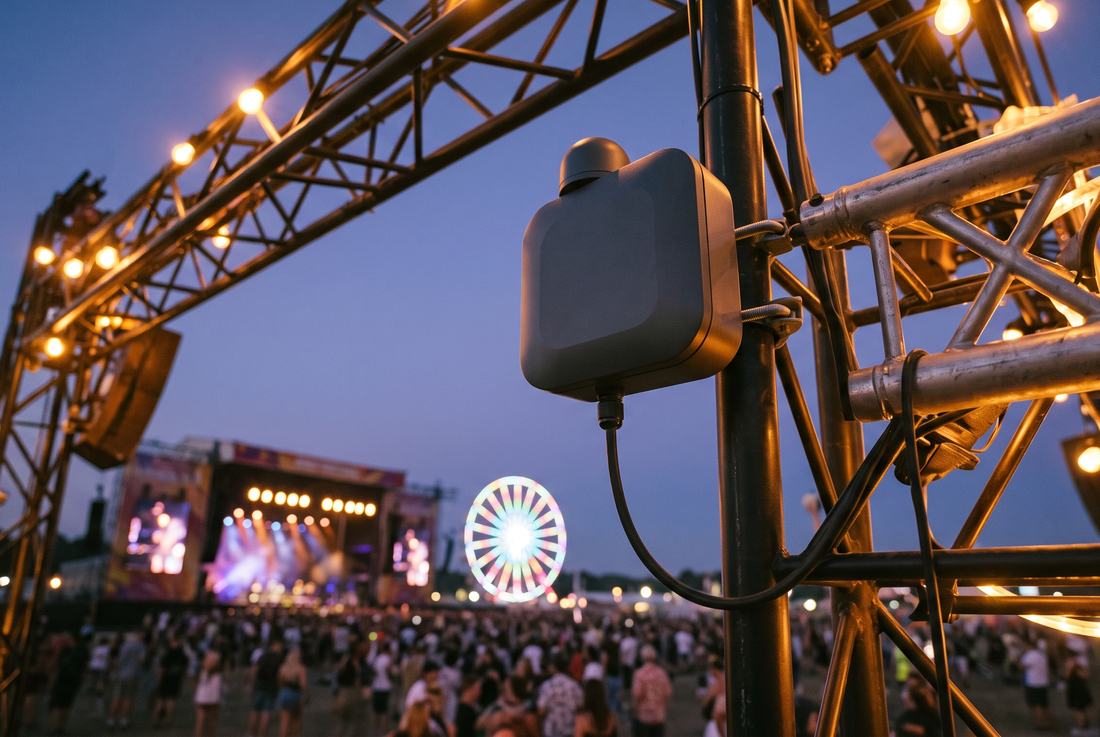
  • Anchors fixed at height on existing site infrastructure: masts, sound and lighting towers, stage structures.
  • A power feed per anchor. The anchors synchronise with each other over radio, so there is no cabling to run between the points.
  • Anchor positions surveyed accurately, since the calculation depends on them.
  • A slot during the site build, and another during breakdown.
A compact matt grey anchor with a small antenna dome, fixed at height on a stage structure, with the stage, the crowd and a big wheel below at dusk.
Concept visual. An anchor on an existing structure. One cable, the power feed.
03Against what exists today

What the other approaches do, and where they stop.

Several systems answer part of the need. The table below sets out what each one covers, including the point where Bermud is the most demanding.

Comparison of positioning approaches on a festival site
CapabilityBermudSmartphone GPS appConsumer beacons
Accuracy in open ground≈ 1 m≈ 5 m≈ 5 m
Accuracy in a dense crowd≈ 2 m10 to 20 m10 to 50 m
Reliance on the mobile networkNoneTotalNone
Reliance on GPSNoneTotalYes
Guide someone to a precise pointYesDegraded in a crowdDegraded
Infrastructure to installYes, an anchor networkNoneNone

When the crowd is dense, the GPS signal is harder to pick up, which costs accuracy. With Bermud anchors installed on site, the tags need neither 4G nor GPS. They stay reliable however many people are packed into the same place.

04Legal and regulatory context

What to plan for before a deployment.

Personal data

The coordinates and movement history of tag wearers are not stored by Bermud: they are available in real time only. The organiser remains the data controller, Bermud acts as a processor.

Tags worn by your employees

If you equip your teams, tracking the position of employees during their shift falls under employment law. It calls for a purpose limited to safety, information given to the people concerned, and consultation of employee representative bodies before deployment. We provide the material to put in front of them.

Regulation

The installation complies with European decision 2024/1467, which governs the outdoor use of ultra-wideband. Tags transmit at around one thousandth of the power of a mobile phone, and far less often. We provide the figures and the standards behind them, IEEE 802.15.4z for the radio layer and ETSI EN 302 065 for European conformity, ready to put in front of the public or staff representatives.

05Next

Let us talk about your event.

An hour is enough to look at your site plan, estimate how many anchors it would take, and see what the system would change about your call-outs. The prototype is being built, there is nothing to sign.