Architecture
How is a position computed?
The tag transmits, the site anchors listen and compute. All the work happens in the infrastructure, which leaves a tag that stays simple and cheap.
01The tag
A minimal device.
A screen, a few sensors, a battery and four buttons.
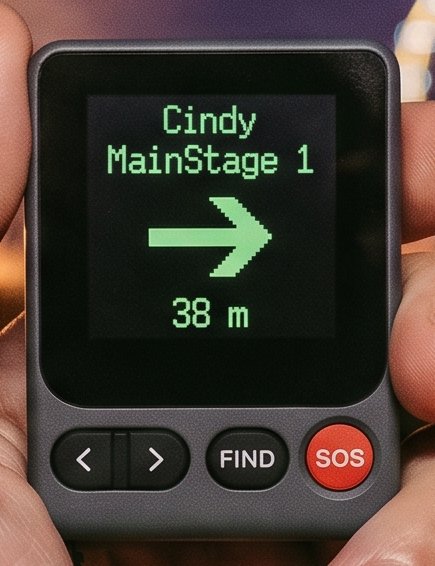
Composition
| Radio | DW3000 ultra-wideband transceiver |
|---|---|
| Processor | nRF52 microcontroller, Bluetooth Low Energy built in |
| Display | Monochrome OLED screen |
| Sensors | Accelerometer |
| Controls | Two arrows, a FIND button, an SOS button |
| Power | Lithium polymer battery, 250 to 400 mAh |
| Target form | Thick key-fob style enclosure rather than a flat badge |
02The anchors
Everything sits in the infrastructure.
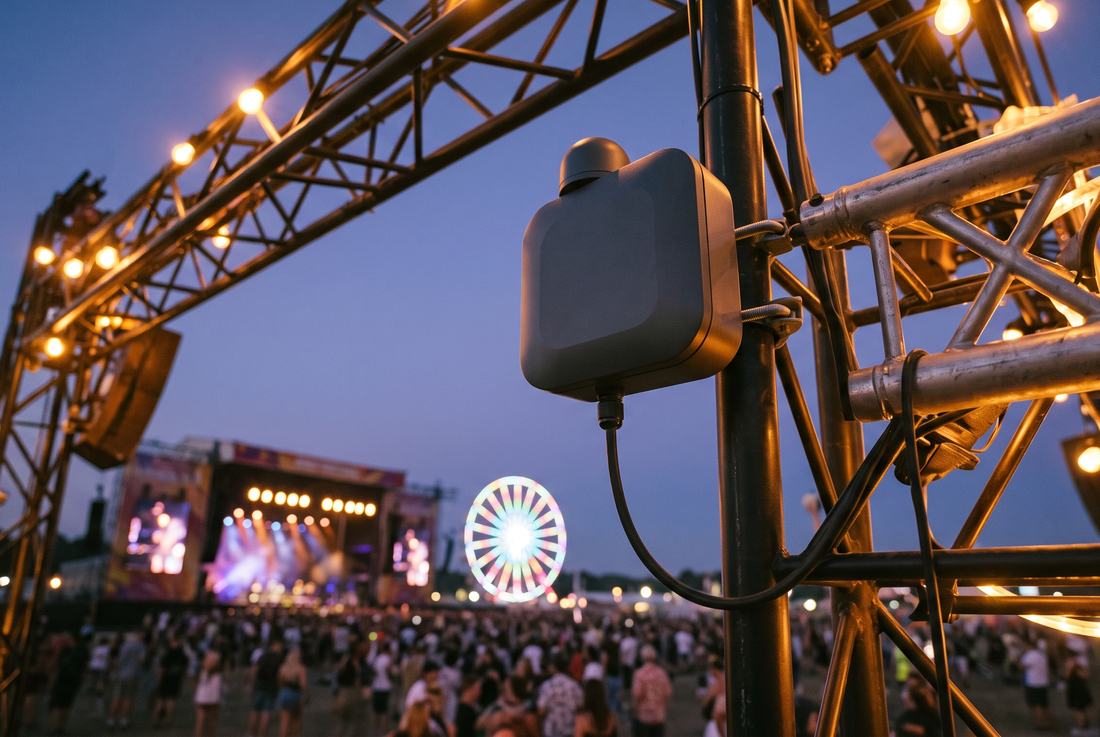
The tag computes nothing. The anchors carry the whole system: they locate, they route requests between tags, and they feed the control room dashboard.
- They compute the position of every tag on site, and keep it current.
- They route searches from one tag to another, and send back the direction to display.
- They track the movement of medical and security teams, and report their positions to the control room.
- They synchronise with each other over radio. There is no cabling to run between the points, only a power feed per anchor.
- They are fixed at height on the existing site infrastructure, at accurately surveyed positions.
03Range and accuracy
Two-metre detection, across the whole festival.
| Target accuracy | Around 2 m, in a properly covered zone |
|---|---|
| Estimated range | 50 to 100 m from an elevated anchor, in line of sight |
| Transmit power | Up to −41.3 dBm/MHz EIRP, the European limit. In the order of one thousandth of the power of a mobile phone while transmitting. |
| Standards | IEEE 802.15.4z for the radio layer, ETSI EN 302 065 for European conformity |
04Next
Prototype under development
We are currently building a first working prototype. If you would like to know more, get in touch with us.